



A test case template is a reusable structure that defines every field a test case needs, so your team writes cases the same way every time instead of starting from a blank page. A good test case template covers the ID, summary, preconditions, steps, test data, and expected result, and it turns test writing into a fast, repeatable task.
Every QA engineer works with test cases throughout their career, but writing them from scratch each time wastes hours and invites inconsistency. This guide explains what a test case template is, gives you a standard test case template you can copy, and shows specialized versions, an agile test case template and a test case document template, plus a worked example you can adapt.
What Is a Test Case Template?
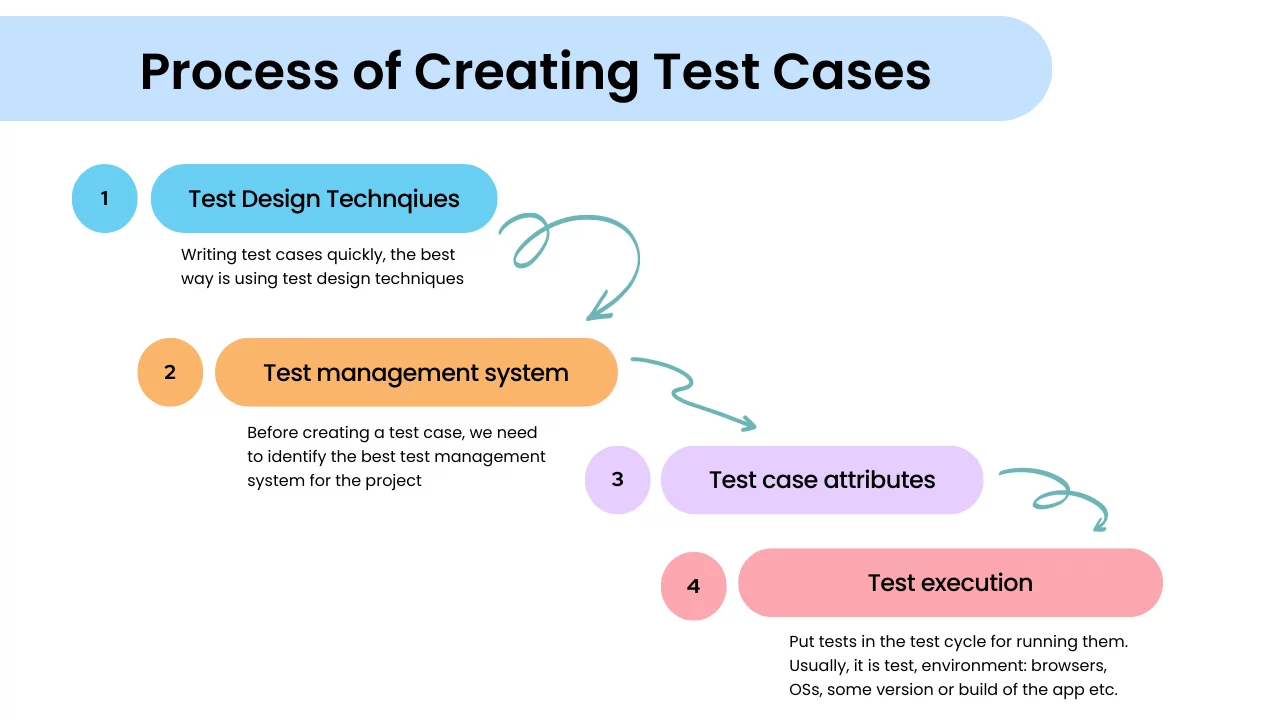
A test case is a set of actions performed on a system to check that it meets requirements and works correctly. A test case template is the skeleton for that: a consistent format that lists the fields every case should carry. Using one means your test cases template stays uniform across the team, which improves coverage, reuse, and readability.
The core fields in almost any test case template are:
- Test summary. A short title describing the functionality being verified.
- Test ID. A numeric or alphanumeric identifier used to group cases into suites, usually generated automatically.
- Description. One or two sentences on what the test intends to verify.
- References. Links to the user stories, specs, or requirements the test covers.
- Preconditions. What must be true before the test can run.
- Test setup. What the case needs to run, such as app version, OS, or security settings, chosen when you pick a test cycle or run.
- Test steps. The sequential actions to complete the test.
- Expected results. How the system should respond at each step.
Standard Software Test Case Template
Here is a standard software test case template you can copy into a spreadsheet or a test management tool. It works as a general-purpose QA test case template for functional and manual checks.
| Field | Value |
|---|---|
| Test ID | TC-001 |
| Test summary | Short title of what is verified |
| Description | One or two sentences on the goal |
| References | Link to user story or requirement |
| Preconditions | State required before running |
| Test data | Inputs used during the steps |
| Test steps | 1. Step one 2. Step two 3. Step three |
| Expected result | How the system should respond |
| Actual result | Filled in after execution |
| Status | Passed or failed |
This manual test case template keeps every field a tester needs in one place, and it scales into a set of manual test cases template rows when you document a whole feature. Keep the steps short, aim for ten at most, and split anything longer into a second case. For the mechanics of authoring cases in this format, see the guide on how to add a classical test case.
Agile Test Case Template
An agile test case template trades some of the formality of the classic format for speed and traceability, since Agile teams write and change cases every sprint. It builds on the user story and acceptance criteria rather than a long specification.
| Field | Value |
|---|---|
| Test ID | TC-Sprint12-003 |
| User story | As a user, I want to reset my password |
| Acceptance criterion | Reset link expires after 30 minutes |
| Preconditions | Account exists, email is verified |
| Test steps | 1. Request reset 2. Open link after 31 minutes 3. Attempt reset |
| Expected result | System rejects the expired link |
| Priority | High |
| Status | Passed or failed |
This agile test case template maps each case to a story and a single acceptance criterion, which keeps testing aligned with what the sprint committed to deliver. Writing cases in the Gherkin Given-When-Then style fits this model well, and you can go deeper in the guide to writing BDD test cases in Agile with examples and templates .
Test Case Document Template
A test case document template is the wider container that holds many cases plus the context around them, used when you need to hand testing over as documentation or share it with stakeholders. Where a single case template covers one check, the test case document collects them under project-level headers.
A typical test case document template includes:
- Document header. Project name, module, version, author, and date.
- Scope. What functionality this document covers and what it excludes.
- Environment. Browsers, operating systems, and builds under test.
- Test cases. The full set of individual cases, each following the standard template above.
- Traceability. A mapping of cases to requirements or user stories.
- Summary. Pass and fail counts and any open defects.
Kept in a spreadsheet, a test case document works, but it goes stale quickly and is hard to reuse. A test management system holds the same structure while keeping history, traceability, and reporting live, which is why teams move their test case document out of static files.
How to Choose a Test Management System for Your Templates
Before you standardize on a template, pick where it will live. A few criteria matter:
- Cost. Paid or free, depending on the project budget.
- Integration. Whether it connects to Jira, Git, and other tools your team already uses.
- Formatting. How you edit, save, export, and import cases, plus the metrics it exposes.
- Test type support. Whether it handles manual, automated, and performance cases together.
Test Design Techniques Behind Good Test Cases
A template gives you structure, but test design techniques give you the content. When deciding what each case should check, common testing scenarios template approaches include equivalence partitioning and boundary values for input fields, decision tables for combinations of choices, state transition for workflows, pairwise testing for many combinations, use case testing for user-facing flows, exploratory testing for open investigation, and error guessing for likely trouble spots. Applying these while you fill a use case testing template makes each case purposeful rather than arbitrary, and the test design techniques guide covers each in depth.
Test Data Template
Clear inputs are half of a reliable test, so a test data template is worth keeping alongside your cases. It lists the values a case consumes, grouped by intent.
| Data type | Example |
|---|---|
| Valid input | testuser@example.com / Passw0rd123 |
| Invalid input | wronguser@example.com / WrongPass1 |
| Boundary input | Exactly at the field’s min or max |
| Empty input | Blank required fields |
Separating the test data template from the steps means one case can run against many data sets. This is where parameterization helps: pass several values into one case and run each as a variation, which you can set up with test parameterization .
Worked Example: A Reusable Test Case
Here is a compact test case example that fits the standard template and reuses steps, which is the fastest way to apply a test case design template in practice.
Test summary:
Verify response when deactivating a customer Preconditions:
- A customer exists with a valid email
- An active contract is linked to the customer Steps:
1. Create a customer with a valid email
2. Find the linked contract
3. Send: curl --location --request DELETE "http://someapi/v1/contracts/216592?deprovision=true" Expected result:
204 No Content
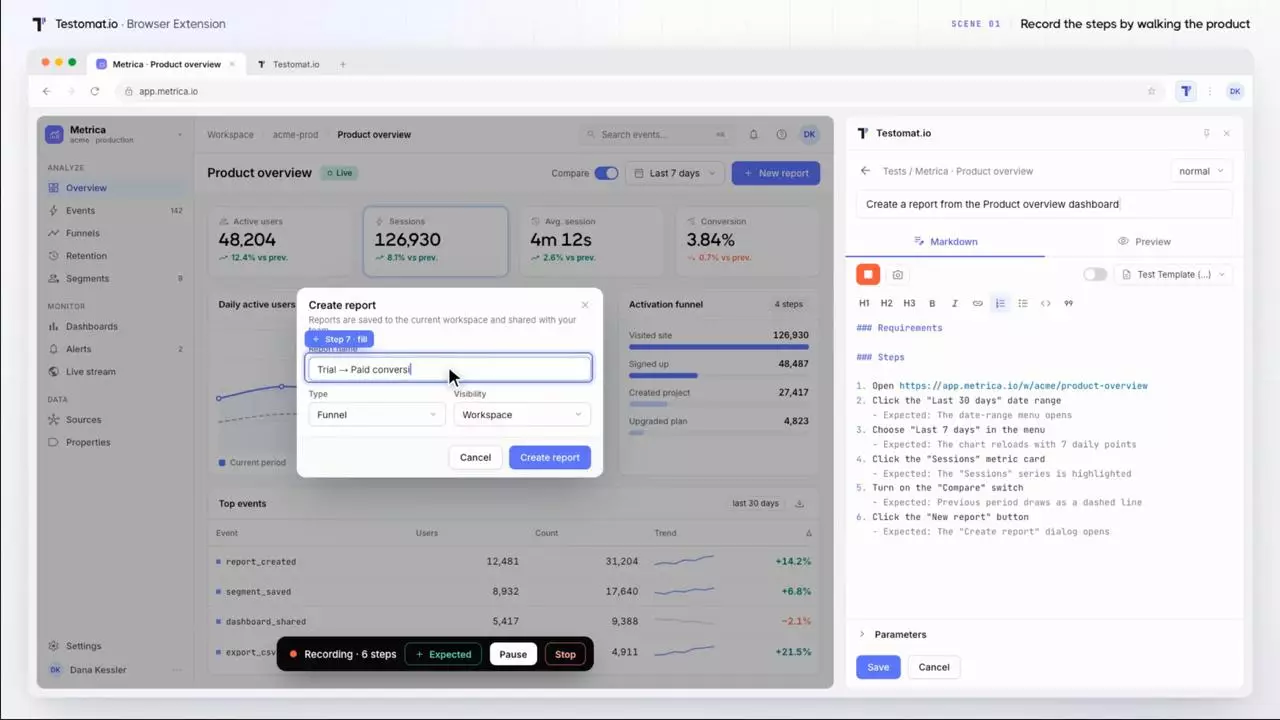
In a test management tool, steps like these can be saved once and reused across cases, and written in markdown or stored as snippets. That reuse is what turns a template from a static form into a fast authoring workflow. For a full walkthrough of writing manual cases end to end, see how to write test cases in manual testing.
Best Practices for Using a Test Case Template
A template only helps if you use it well. Keep these in mind:
- Write unique cases and avoid duplicates.
- Keep titles short and each case transparent.
- Break steps into the smallest sensible segments, ten at most.
- Skip an obvious expected result when the step already implies it.
- Keep the end user in mind for every case.
- Write so others can understand and update the case later.
- Make each case easily identifiable by ID.
Turn Templates into a Workflow with Testomat.io
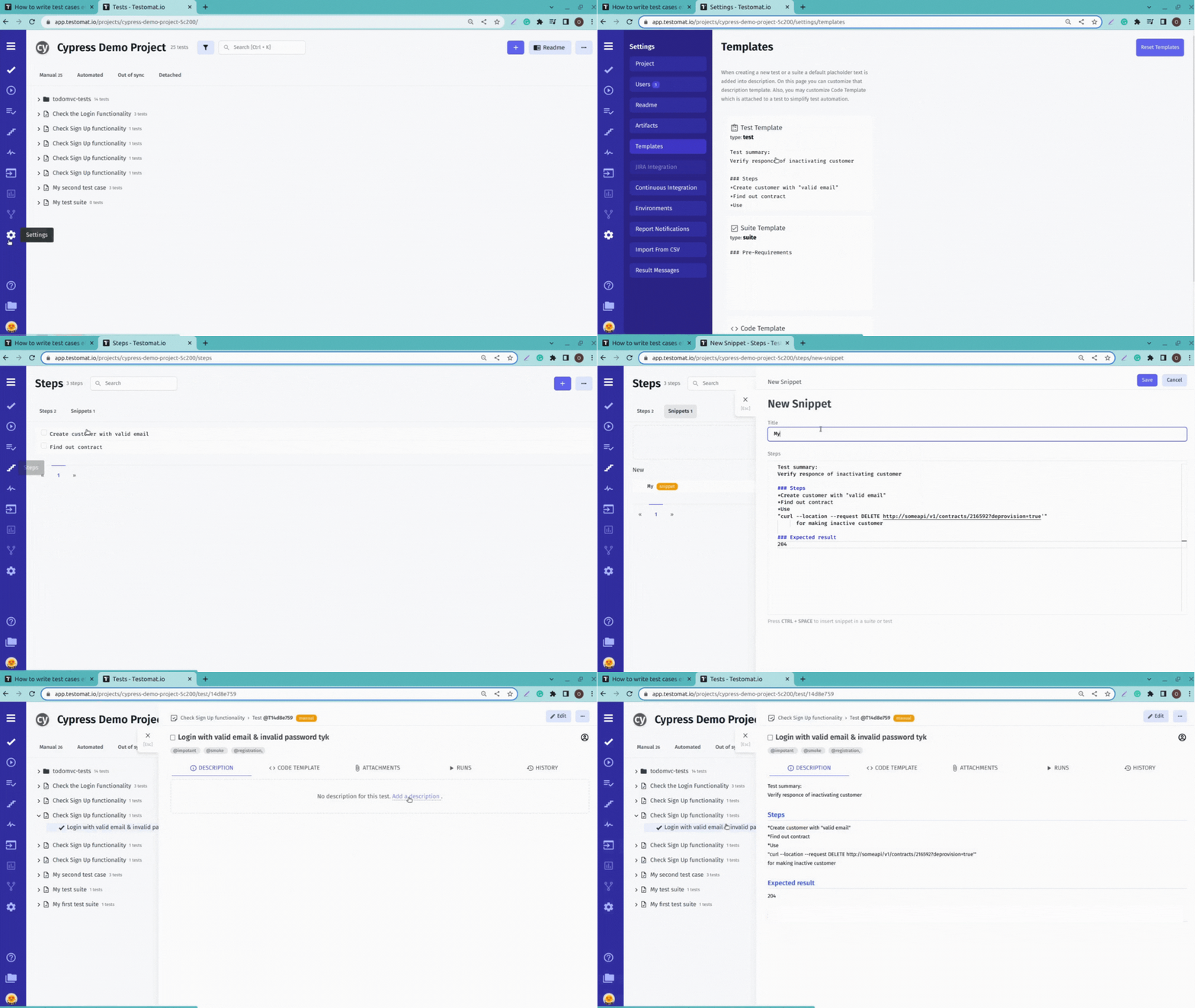
A test case template solves consistency, but a spreadsheet full of templates still ages badly and hides your history. Testomat.io is not a spreadsheet or a test runner. It is the management, reporting, and visibility layer where your templates become reusable elements, built-in test case templates, a shared steps database, snippets, and parameters, so writing a new case takes a few clicks. Import your cases, reuse steps across them, and track execution and history in one workspace.